 This documentation is released under the Creative Commons license
Uses host index as network and MAC address.
It assumes that hosts are declared as an array of NED modules, and returns for both the level 2 and level 3 addresses, the index of the current host in this array.

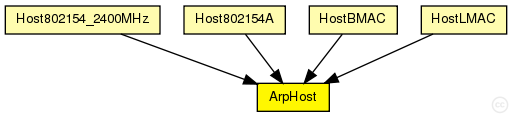
The following diagram shows usage relationships between types. Unresolved types are missing from the diagram. Click here to see the full picture.
The following diagram shows inheritance relationships for this type. Unresolved types are missing from the diagram. Click here to see the full picture.
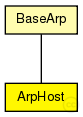
| BaseArp (simple module) |
Module which is responsible for Addressresolution |
If a module type shows up more than once, that means it has been defined in more than one NED file.
| Host802154_2400MHz (compound module) |
This NED module defines a host using an IEEE 802.15.4 transceiver at 2.4GHz for wireless communications, that can be used to simulate wireless sensor networks. |
| Host802154A (compound module) |
This host NED module models a host using an IEEE 802.15.4A correlation receiver. |
| HostBMAC (compound module) |
Example host module using a BMAC Network interface card. |
| HostLMAC (compound module) |
Example host module using a LMAC Network interface card. |
| Name | Type | Default value | Description |
|---|---|---|---|
| notAffectedByHostState | bool | true | |
| coreDebug | bool |
debug switch for the core framework |
|
| debug | bool | false |
enable debugging for this module |
| offset | int | 0 |
Adds an offset to node addresses |
| Name | Value | Description |
|---|---|---|
| class | ArpHost |
// Uses host index as network and MAC address.
//
// It assumes that hosts are declared as an array of NED modules,
// and returns for both the level 2 and level 3 addresses, the
// index of the current host in this array.
simple ArpHost extends BaseArp
{
    parameters:
        @class(ArpHost);
        bool debug = default(false); 	// enable debugging for this module
        int offset = default(0);  		// Adds an offset to node addresses
}
This documentation is released under the Creative Commons license