 This documentation is released under the Creative Commons license
Multi-hop ad-hoc data dissemination protocol based on probabilistic broadcast, with adaptive parameters.
This protocol performs network-level broadcast using a probabilistic mechanism. This method reduces the number of packets sent on the channel (reducing the broadcast storm problem) at the risk of some nodes not receiving the data. It is particularly interesting for mobile networks. This version of probabilistic broadcast automatically adapts transmission probabilities depending on the estimated number of neighbours. timeInNeighboursTable is its unique parameter, and sets the time during which the node remembers a neighbour. It is particularly important in mobile networks: in that case, the faster the nodes, the smaller the timeInNeighboursTable parameter.

The following diagram shows usage relationships between types. Unresolved types are missing from the diagram. Click here to see the full picture.

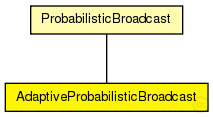
The following diagram shows inheritance relationships for this type. Unresolved types are missing from the diagram. Click here to see the full picture.
| ProbabilisticBroadcast (simple module) |
Multi-hop ad-hoc data dissemination protocol based on probabilistic broadcast. |
| Name | Type | Default value | Description |
|---|---|---|---|
| notAffectedByHostState | bool | false | |
| coreDebug | bool |
debug switch for core framework |
|
| stats | bool |
stats switch |
|
| headerLength | double |
length of the network packet header (in bits) |
|
| debug | bool | false |
debug and trace switches |
| trace | bool | false | |
| bcperiod | double | 2 s |
period between two probabilistic broadcast attempts |
| beta | double | 0.8 |
probability of broadcast for each attempt |
| maxNbBcast | double | 1 |
maximal number of broadcast attempts for each packet. |
| maxFirstBcastBackoff | double | 1 s |
maximal back-off before first broadcast attempt [seconds]. if don't want to use this parameter, simply set it to a value that is greater than bcperiod. |
| timeToLive | double | 10 s | |
| timeInQueueAfterDeath | double | 60 s |
How many seconds the message should be kept in queue after its died. That way the message is known if the node receives one of its copy that isn't dead because of TTL de-synchronization due to MAC backoff, propagation delay and clock drift. |
| timeInNeighboursTable | double | 60 s |
| Name | Value | Description |
|---|---|---|
| class | AdaptiveProbabilisticBroadcast |
| Name | Direction | Size | Description |
|---|---|---|---|
| upperGateIn | input |
from upper layer |
|
| upperGateOut | output |
to uppe layer |
|
| upperControlIn | input |
control from upper layer |
|
| upperControlOut | output |
control to upper layer |
|
| lowerGateIn | input |
from lower layer |
|
| lowerGateOut | output |
to lower layer |
|
| lowerControlIn | input |
control from lower layer |
|
| lowerControlOut | output |
control to lower layer |
// Multi-hop ad-hoc data dissemination protocol based on probabilistic broadcast, with adaptive parameters.
//
// This protocol performs network-level broadcast using a probabilistic mechanism.
// This method reduces the number of packets sent on the channel (reducing the
// broadcast storm problem) at the risk of some nodes not receiving the data.
// It is particularly interesting for mobile networks.
// This version of probabilistic broadcast automatically adapts transmission
// probabilities depending on the estimated number of neighbours.
// timeInNeighboursTable is its unique parameter, and sets the time
// during which the node remembers a neighbour. It is particularly important
// in mobile networks: in that case, the faster the nodes, the smaller the
// timeInNeighboursTable parameter.
simple AdaptiveProbabilisticBroadcast extends ProbabilisticBroadcast
{
    parameters:
        @class(AdaptiveProbabilisticBroadcast);
        double timeInNeighboursTable @unit(s) = default(60 s);
}
This documentation is released under the Creative Commons license